


When an owner tells me they’re thinking about selling in the next few years, the first question is almost always the same: What should I be doing now?
My answer starts with an equation, not with buyers or market timing. Almost everything worth doing before a sale moves one of its three parts.
The equation
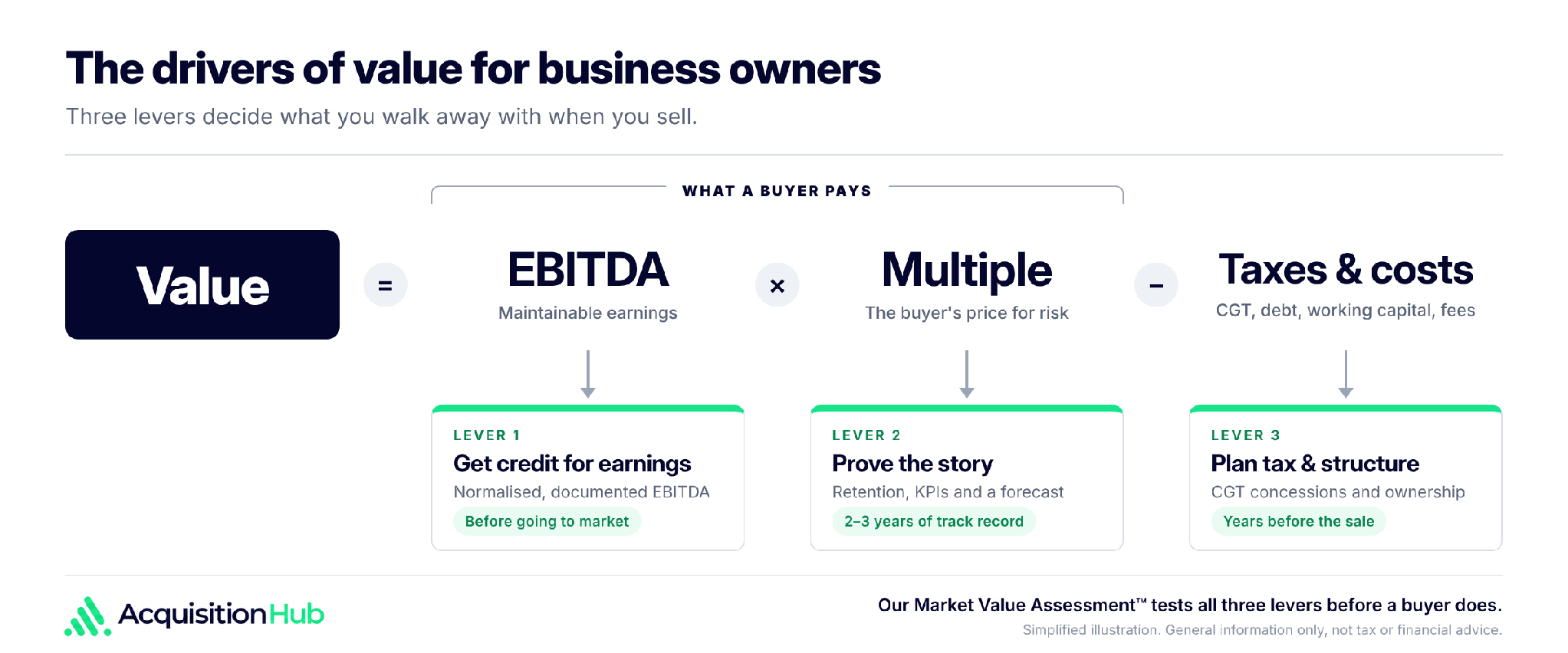
Value = EBITDA × multiple − taxes and costs
Most businesses are priced on maintainable EBITDA times a multiple. What you keep is that figure less the tax and the costs of getting the deal done.
Three numbers, three levers. They don’t behave the same way. One can be pulled in the year before a sale. One needs two or three years of track record behind it. And one often depends on decisions made long before a buyer makes contact.
Lever 1: Get credit for every dollar you earn
A buyer applies the multiple to your normalised EBITDA, so the real question is who settles that number.
Leave it to the buyer; their due diligence settles it for you after the price is agreed and your leverage has dropped. Their accountants protect the buyer. Adjustments in your favour only count if someone on your side has found them, documented them and is ready to defend them.
That’s why I recommend owners have their earnings normalised independently before going to market: reset the owner’s salary to a market rate, add back personal and one-off costs, remove non-recurring income, and adjust related-party rent to market. Every supported dollar is worth the multiple. Miss $50,000 in a business that sells at four times EBITDA and you’ve given away $200,000.
It also removes surprises from due diligence. Anything negative comes out early, while you can still explain it on your terms.
Lever 2: Give the buyer a story they can bank on
Your financial statements tell a buyer what happened. They’ll pay more when they also understand why it happened and what comes next.
Every owner has a story about their business. Buyers, and the banks funding them, only pay for the parts the numbers support. If you say your clients stay, show retention by year. If you say they spend more over time, show it. If you say no single customer can hurt you, show the concentration. If you say the business runs without you, show the months it did.
Then build a forecast of what actually drives your revenue and costs. When a buyer believes next year’s number, they pay a higher multiple for it, and less of the price gets deferred in an earn-out. The best way to exit is to sell what the market wants to buy, and buyers decide what they want from evidence.
This lever takes time. A KPI you only started tracking this year carries little weight. Three years of consistent reporting on the same measures is evidence.
Lever 3: Plan for tax and costs before anyone makes an offer
Owners tend to leave tax until a buyer is at the table. By then, most of the decisions that matter have already been made.
For many owners, the small business CGT concessions are the biggest single factor in what they keep. Take an owner aged 60 who has held the business for more than 15 years and is selling to retire. If the conditions are met, the 15-year exemption can mean no capital gains tax on the sale at all. Change one fact, such as an investment property in a related family trust that pushes the group over the $6 million net asset value test, and the same sale can produce a tax bill of several hundred thousand dollars.
None of that is decided at settlement. It comes down to how the business and the assets around it are owned, how long they’ve been held, and whether you sell shares or assets. Some of it can be changed, but changes take time and can carry their own tax cost.
Costs belong in the same conversation. Debt repaid at completion, the working capital a buyer expects to stay in the business, and advisory and legal fees all come off the headline price. Hand over less working capital than agreed and the price comes down dollar for dollar.
The concessions are technical, and this is specialist work. Speak with your accountant early, while the options are still open.
So where do you start?
Start with whatever takes the longest. Usually that means tax and structure first, then the metrics and forecast, with earnings normalisation closer to going to market.
That’s the reverse of how most owners approach it. They focus on the price a buyer will offer and leave what they’ll keep until last.
Our Market Value Assessment™ (MVA) gives you a starting point on all three numbers:
- EBITDA: normalised earnings, with the adjustments a buyer is likely to accept or challenge.
- Multiple: an assessment of size, industry and business-specific risk against market evidence, showing what supports your multiple and what holds it back.
- Taxes and costs: a bridge from value to estimated net proceeds, so the structuring conversation with your accountant starts from a real number.
You get a supported valuation range and a short list of the changes worth making, ranked by the value they add and how long they take.
Whether or not you sell, every one of these improvements makes the business worth more to you. If a sale is anywhere on the horizon, start a few years out, while there’s still time to change the answer.
Know your numbers before a buyer does
Our Market Value Assessment™ gives you a supported valuation range and a risk reduction strategy to expand your multiple.
Confidential, and no decision to sell required.
This article is general information only and does not take into account your circumstances. Speak with your accountant before making tax or structuring decisions.