


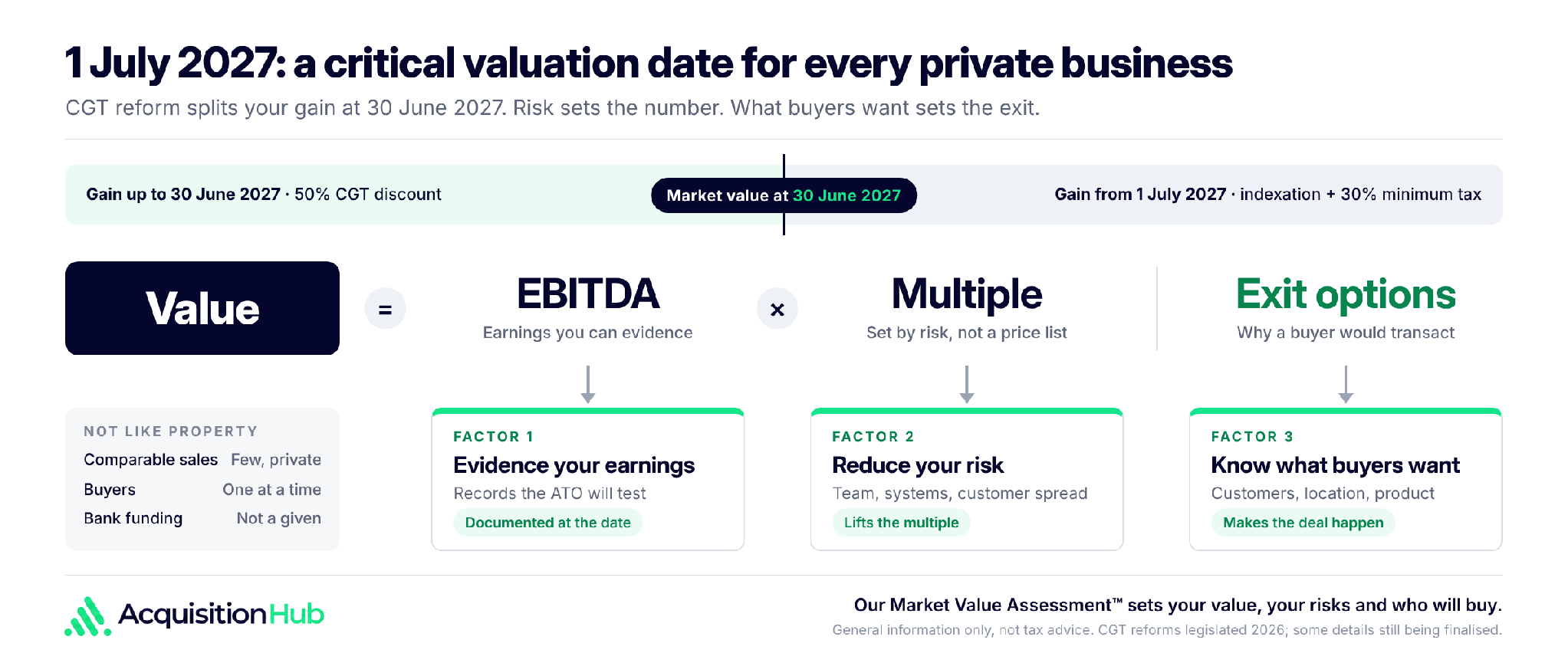
From 1 July 2027, capital gains are taxed differently for individuals and trusts. The 50% CGT discount is replaced by cost base indexation, with a 30% minimum tax on gains made after that date. To separate the old rules from the new, assets held on 30 June 2027 are treated as sold and bought back at their market value on that day. That includes shares and units in private companies and trusts.
For listed shares, that value is a closing price. For an investment property, a valuer can point to recent sales down the street. A private business has neither. Someone has to work the number out, and it matters: the higher the supportable value at 30 June 2027, the more of your eventual gain stays under the old rules with the 50% discount.
That makes 30 June 2027 one of the most important valuation dates private business owners in Australia will face.
The equation hasn’t changed
Value = EBITDA × multiple
Most private businesses are still valued on maintainable earnings times a multiple. The new rules don’t change that. They change how much rides on getting it right, and how closely the number may be examined when you eventually sell.
There is an alternative to a valuation: an apportionment formula that estimates your 30 June 2027 value. But it assumes value builds evenly over time, and businesses rarely grow that way. A major contract, a lost client or a new manager can move value sharply in a single year. A formula won’t see any of that.
Comparables only get you so far
There is no single right way to value a private business. Industry multiples, sale databases and broker rules of thumb all have a place, but none of them is a price list. Deals are private, terms are rarely disclosed, and a headline multiple often hides an earn-out, vendor finance or assets that weren’t included.
This is where owners, and plenty of advisors, get stuck: debating whether the right multiple is 3.2 or 3.8. In my experience, that is rarely the real issue.
A business isn’t a tradeable asset
A house can be sold on any given Saturday. There is a deep pool of buyers, recent sales to compare against and a bank willing to lend. A private business has none of that. It’s one asset, sold to one buyer at a time, and many businesses never find a buyer.
A few factors determine what happens when you sell; you should understand them long before a buyer calls.
1. Earnings with evidence
Every valuation starts with earnings, and the ATO, like a buyer, will expect supporting evidence. Owner’s salary reset to market, related-party rent, one-off costs, each adjustment needs supporting records. Evidence prepared at the time carries far more weight than a reconstruction put together years later, when you finally sell and the value is under review.
2. Reduce risk to lift the multiple
The multiple is the market’s price for risk. Heavy reliance on the owner, one or two customers carrying the profit, staff or a lease that won’t transfer, records that don’t reconcile: each pushes the multiple down. Two businesses with the same profit can sit a full multiple or more apart.
The good news is that most of these are organisational, and owners still have time to fix them:
- hand key client and supplier relationships to a manager, and step back from the day to day
- spread revenue so no single customer carries the profit
- put staff, key customers and the lease on written terms that transfer to a new owner
- get monthly reporting in place that reconciles to the accounts
Each change takes time to show up in the trading record a buyer will look at, which is why it pays to start now. Keeping the status quo will never shift that number.
3. What buyers want
This is the part most valuations leave out. Risk shapes the price, but it rarely decides whether a deal happens on its own. Transactions get done because of what the business gives the buyer, not what the seller wants to get out of it:
- new customers or a client base they can’t win themselves quickly
- a location, territory or site that’s hard to replicate
- a product, service line or capability that fills a gap
- distribution rights, supply agreements, licenses or a team with skills they can’t hire
A buyer with a strong reason to transact will work through risk, structure around it and still pay for what they want. A business with no clear reason to buy it will struggle to sell at any multiple. The best way to exit is to sell what the market wants to buy, and that starts with knowing who your likely buyers are and what would bring them to the table.
A valuation on 30 June 2027 tells you what the tax rules need. It doesn’t tell you who will buy, what they would pay for, or whether you’re building the business they want.
Where to start
Get a supported value in place before 30 June 2027 and use it for more than tax.
Our Market Value Assessment™ (MVA) gives you:
- A supported valuation range, with the earnings adjustments documented and the method explained, so your accountant has a defensible starting point for the CGT transition.
- The risks holding your multiple back, ranked by their impact on value, and the changes most likely to lift it.
- A clear read about your exit options: who your likely buyers are, what in your business they would pay for, and what would hold a deal back.
Done now, it gives you a benchmark ahead of the transition date, and time to reduce the risks and build what buyers want before you ever test the market.
The tax rules need a number on 30 June 2027. You need to know what will limit your exit while there’s still time to change the outcome.
Know your number and your options
Our Market Value Assessment™ gives you a supported valuation range for the transition and the risks holding your multiple back.
Confidential, and no decision to sell required.
General information only. The CGT changes were legislated in 2026, but some details, including the apportionment method and small business carve-outs, are still being finalised. Speak with your accountant about your circumstances before making tax or structuring decisions.